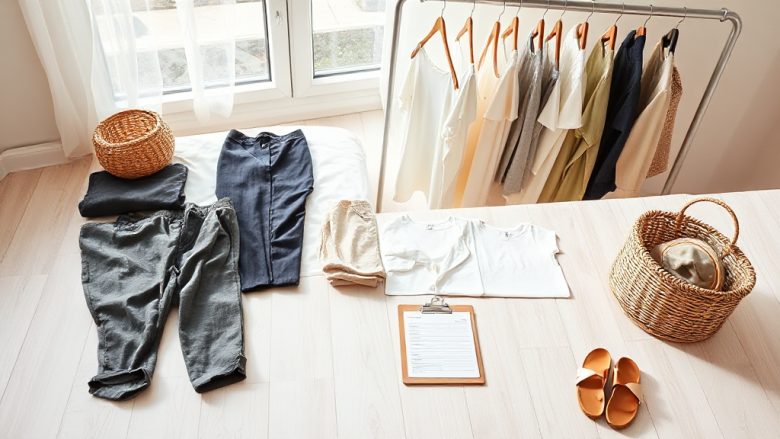
Before you buy a single thing this spring, pull everything out of your wardrobe. All of it — the stuff on the rail, the pile on the chair, the bin bag at the back you keep meaning to deal with. Sort it into three stacks: keep, maybe, donate. Then, and only then, decide on a colour story. That order matters more than any shopping list, because most capsule wardrobe ideas for women fail at the very first step: people buy a beautiful new set of clothes before they know what they already own.
A capsule isn’t a uniform and it isn’t minimalism for its own sake. It’s a small set of clothes that all work together, so getting dressed takes four minutes instead of forty. For spring and summer, a 30-piece capsule is the sweet spot. It’s enough variety for real life and small enough to fit on one rail without a fight. Here’s how to build yours from what’s already hanging up.
Why Most Capsule Wardrobes Fall Apart by May
The usual failure isn’t discipline. It’s buying. A woman reads a capsule wardrobe guide, orders ten new pieces in one weekend, and by the middle of May she’s bored, the weather has done something unexpected, and half the new items don’t match anything she kept. The capsule collapses because it was built as a shopping project rather than an editing project.
The second common mistake is choosing a palette that looks good on a mood board but not in her actual life. All-cream everything photographs beautifully and survives approximately one commute. Third: ignoring laundry reality. If you wash once a week, a capsule of delicate, hand-wash-only pieces will run out by Wednesday. Fourth: no swap logic. Seasons don’t switch on a single date, so a capsule with no plan for the in-between weeks feels broken even when it isn’t.
Fix those four things and the rest is straightforward. Keep reading, because the build process below is deliberately slow — it takes an afternoon, not a payday.
The Five-Step Build: From Full Rail to 30 Pieces
Step one: the honest sort. Empty the wardrobe completely. Try things on if you’re unsure, but set a rule in advance so you don’t negotiate with yourself: if it doesn’t fit now, if it needs repairing and has needed it for over a year, or if you’d avoid being photographed in it, it goes in the donate stack. Be generous with the maybe stack — you’ll revisit it at the end, and some pieces will earn their place once you see the whole picture.
Step two: find your colour story. Lay your keep stack on the bed and look at what’s actually there. Most women discover they already lean towards two or three neutrals plus one or two colours they genuinely wear. That’s your palette. Write it down. A workable spring palette is usually two neutrals (say, navy and soft white), one grounding dark (charcoal or chocolate), and two accent colours you already own and love. Everything you add from here should connect to that list.
Step three: count what you have by category. Separate the keep stack into tops, bottoms, layers, dresses, shoes and accessories. Most people find they’re top-heavy — lots of tops, very few bottoms that fit properly. That imbalance is why the wardrobe feels full and empty at the same time.
Step four: fill only the gaps. Now, and only now, make a short list of what’s missing to make the pieces work together. Usually it’s two or three items: a neutral layer, a bottom in your grounding colour, a shoe that works for both smart and casual. Buy those, not a whole new wardrobe.
Step five: test ten outfits before you commit. Photograph them on your phone. If you can’t build ten outfits from the 30 pieces without repeating the same combination, something in the capsule isn’t pulling its weight. Swap it out rather than adding to it.
Your 30-Piece Spring and Summer Checklist
This is the printable part. Copy it into your notes app or write it on the back of an envelope and stick it inside the wardrobe door. The numbers are a guide, not a law — shift one or two between categories to suit your life. If you work in an office five days a week, take one from dresses and add it to tops. If you’re mostly at home with small children, do the reverse.
Tops — 8 pieces. Two plain cotton or linen t-shirts in your neutrals. Two slightly nicer short-sleeve tops you’d wear to lunch. Two longer-sleeve lightweight tops for cool mornings. One button-down shirt that works tucked or open over a t-shirt. One top in an accent colour that makes you feel good the moment you put it on.
Bottoms — 6 pieces. One pair of well-fitting jeans in a mid or light wash. One tailored trouser in your grounding colour. One wide-leg or straight-leg cotton trouser for warm days. One midi skirt that moves. One pair of shorts you’d actually leave the house in. One casual bottom — linen trousers or easy pull-on style — for weekends.
Layers — 5 pieces. One light cardigan in a neutral. One structured blazer or overshirt. One denim or cotton jacket. One fine knit for cooler evenings. One longline layer — a duster or light trench — for the unpredictable weeks.
Dresses — 4 pieces. One everyday dress in a solid neutral. One patterned or accent dress for when you want to look like you made an effort. One dress that works for a warm-weather occasion. One comfortable knit or jersey dress for low-effort days.
Shoes — 4 pieces. One white or neutral trainer. One flat sandal. One closed-toe flat or loafer. One slightly dressier shoe for evenings or events.
Accessories — 3 pieces. One everyday bag that fits your actual daily contents. One belt. One piece of jewellery you wear constantly — a necklace, a watch, a pair of earrings. Accessories do more work per item than anything else in the capsule, so choose these carefully.
That’s 30. Not 30 new things — 30 in total, including what you already own.
Outfit Formulas That Work From the Same 30 Pieces
The point of a capsule is that combinations become automatic. These formulas are the ones that survive real weather and real schedules.
For an ordinary weekday: a plain t-shirt, your tailored trouser, a light layer, and the neutral trainer. Swap the trainer for the loafer and it reads as a meeting outfit. Swap the trouser for jeans and it’s a weekend.
For warm days: the everyday dress, flat sandals, and one accessory. If it turns cool at four o’clock, add the fine knit over your shoulders or the light cardigan. This is why the layering pieces matter even in summer.
For something that requires effort: the accent dress or the patterned dress, the dressier shoe, and your constant piece of jewellery. Because everything in the capsule shares a palette, this never clashes with your everyday pieces.
For the awkward in-between weeks: the button-down shirt worn open over a t-shirt, wide-leg cotton trousers, and the closed-toe flat. Add the longline layer if the morning is cold. This combination handles a ten-degree temperature swing without a costume change.
One more formula worth knowing: the monochrome column. Top and bottom in the same neutral, with a contrasting layer and shoe. It looks intentional, it’s slimming, and it takes about eight seconds to assemble.
Swap Logic and Keeping the Capsule Alive
A capsule isn’t a fixed set of 30 items forever. It’s a living system, and the swap logic is what keeps it from going stale. At the start of each season, take out the pieces you didn’t wear at all. Be honest about why. Sometimes the answer is that the item is wrong for your life now; sometimes it just needs a different partner piece. If two or three items went untouched, replace them rather than adding on top.
Rotate by weather, not by calendar. Keep the heavier layers and closed shoes accessible at the front of the rail until the mornings are reliably warm, then move them to the back and bring the sandals and lighter dresses forward. A capsule that’s physically organised is a capsule you’ll actually use.
Maintain it with a fifteen-minute reset each week. Refold the keep stack, put anything that needs repairing into one bag, and note anything you reached for repeatedly that isn’t in the capsule. That note becomes your shopping list next season — and it’ll be a short one.
Finally, resist the urge to top up mid-season because you’re bored. Boredom is usually a sign that you need a new combination, not a new purchase. Try the monochrome column. Try tucking the shirt differently. Try the accent dress with the trainer instead of the sandal. The clothes you already own will surprise you more often than a delivery will.
Start with the rail, not the website. Sort, choose your colours, count, fill only the gaps, and test ten outfits before you spend a penny. Do that once, properly, and spring dressing becomes something you barely think about — which is exactly the point.